2026-09-14
Arup and Saint-Gobain Launch Global Report on Adapting Buildings to Climate Change in Hong Kong
Arup and Saint-Gobain jointly hosted the Asia launch of their global report, Adapting Buildings to Climate Change, alongside a technical seminar on AI-enhanced building design and operation. Supported by the Hong Kong Green Building Council, BEAM Society Limited, Business Environment Council, the Hong Kong Institute of Architects, Royal Institute of British Architects and American Institute of Architects Hong Kong, the event brought together more than 100 industry leaders, developers, architects, engineers and sustainability practitioners to examine how the built environment can respond to the growing challenges of climate change. The Hong Kong edition follows the report’s European launch in Brussels earlier this year and marks the beginning of a wider conversation across the Asia Pacific region.
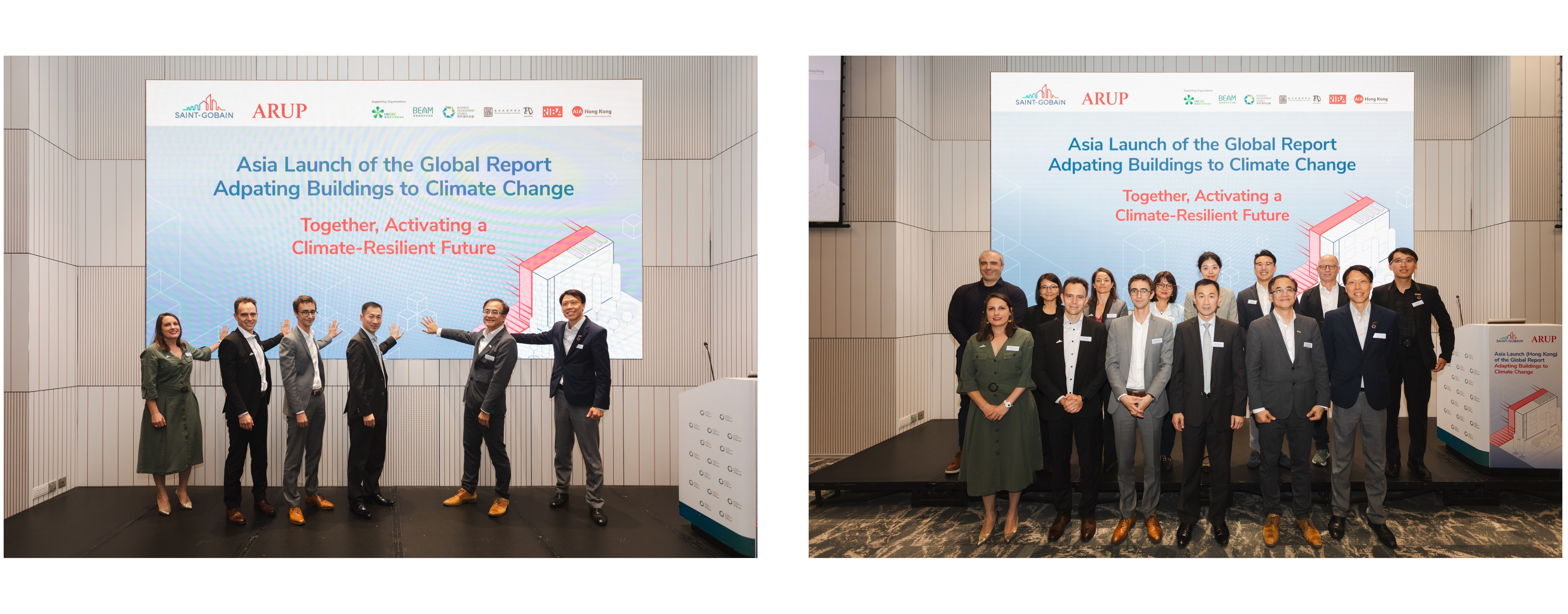
Reflecting the value of collaboration between government and industry, Mr Sammy YEUNG, JP, Commissioner for Climate Change, Environment and Ecology Bureau, HKSAR Government; and Mr Benjamin HUBIN, Deputy Consul General of France in Hong Kong and Macau, graced the launch ceremony as distinguished guests. Their presence underscored a shared commitment to addressing climate challenges and strengthening the resilience of Hong Kong’s built environment.
The urgency of that shared agenda framed the evening’s discussions. The scale of the challenge is significant. More than 7,000 major climate-related disasters caused nearly US$3 trillion in losses worldwide between 2000 and 2019, and the frequency and severity of heatwaves, floods, storms and extreme rainfall continue to rise. As one of the world’s most densely developed cities, Hong Kong faces distinct pressures, with rising temperatures, intensifying rainfall and a large existing building stock reinforcing the need for adaptation alongside decarbonisation. The pressure is particularly acute in dense urban areas, where Arup’s research has found the urban heat island effect can raise city temperatures by up to 8.5°C compared with rural surroundings, putting lives at risk and driving up cooling demand. Against this backdrop, the report examines how buildings can better withstand extreme heat, flooding and storms while supporting the transition to a low-carbon future.
Building on these themes, distinguished speakers and panelists from across the built environment sector shared their perspectives throughout the evening. Through a series of presentations and a panel discussion, they explored how building owners, investors and industry professionals can extend asset life, strengthen resilience and create lasting social and economic value through climate-responsive design, retrofitting and advanced technologies, as well as the growing role of digital innovation and artificial intelligence in enabling smarter, more sustainable decision-making across the building lifecycle.
Learn more: https://www.saint-gobain.com/en/adapting-buildings-climate-change
About the Report
Adapting Buildings to Climate Change explores the impacts of climate change on buildings and sets out strategies to strengthen resilience across the asset lifecycle. It identifies three complementary design approaches, namely robustness, adaptiveness and flexibility, and presents practical families of construction solutions ranging from thermal envelope and solar protection systems to green infrastructure and enhanced-resistance measures. The report highlights the business and societal value of investing in adaptation, showing how proactive measures can safeguard assets, improve occupant wellbeing and support more sustainable, resilient cities.
The urgency of that shared agenda framed the evening’s discussions. The scale of the challenge is significant. More than 7,000 major climate-related disasters caused nearly US$3 trillion in losses worldwide between 2000 and 2019, and the frequency and severity of heatwaves, floods, storms and extreme rainfall continue to rise. As one of the world’s most densely developed cities, Hong Kong faces distinct pressures, with rising temperatures, intensifying rainfall and a large existing building stock reinforcing the need for adaptation alongside decarbonisation. The pressure is particularly acute in dense urban areas, where Arup’s research has found the urban heat island effect can raise city temperatures by up to 8.5°C compared with rural surroundings, putting lives at risk and driving up cooling demand. Against this backdrop, the report examines how buildings can better withstand extreme heat, flooding and storms while supporting the transition to a low-carbon future.
Building on these themes, distinguished speakers and panelists from across the built environment sector shared their perspectives throughout the evening. Through a series of presentations and a panel discussion, they explored how building owners, investors and industry professionals can extend asset life, strengthen resilience and create lasting social and economic value through climate-responsive design, retrofitting and advanced technologies, as well as the growing role of digital innovation and artificial intelligence in enabling smarter, more sustainable decision-making across the building lifecycle.
Learn more: https://www.saint-gobain.com/en/adapting-buildings-climate-change
About the Report
Adapting Buildings to Climate Change explores the impacts of climate change on buildings and sets out strategies to strengthen resilience across the asset lifecycle. It identifies three complementary design approaches, namely robustness, adaptiveness and flexibility, and presents practical families of construction solutions ranging from thermal envelope and solar protection systems to green infrastructure and enhanced-resistance measures. The report highlights the business and societal value of investing in adaptation, showing how proactive measures can safeguard assets, improve occupant wellbeing and support more sustainable, resilient cities.